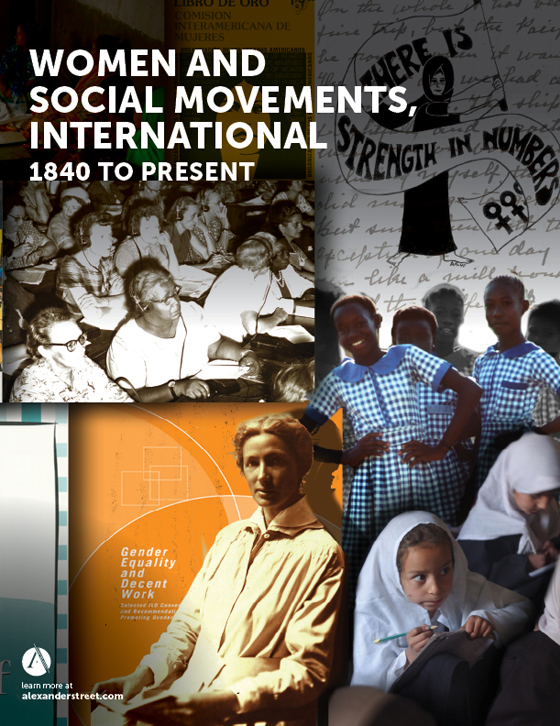
Women and Social Movements, International 1840 to Present
Backed by a global editorial board of 130 leading scholars, Women and Social Movements, International 1840-Present is a landmark collection of primary materials drawn from more than 300 repositories. Assembled and cross-searchable for the first time, these resources illuminate vast areas of modern history. Through the writings of women activists, their personal letters and diaries, and the proceedings of conferences at which pivotal decisions were made, Women and Social Movements, International 1840-Present reveals how women’s social movements shaped many of the events and attitudes that have defined modern life. To the present, women’s international organizations have focused on issues related to peace, poverty, child labor, literacy, disease prevention, and global inequality. Only by exploring traditions of women’s activism can we reach a full understanding of modern society and history.
Edited by Kathryn Kish Sklar and Thomas Dublin, State University of New York, Binghamton
The collection will contain 150,000 pages at completion, mainly in-copyright and previously unpublished primary sources. The conference proceedings of dozens of women’s organizations form the backbone of the project—from the 1840 World’s Anti-Slavery Convention in London to “Beijing + 15,” which in 2010 reviewed implementation of the 1995 Beijing Platform, and including the Casablanca Dream conference of 2007, which united women from the Global South. Readers will discover how the League of Nations, Women’s International League for Peace and Freedom, Inter-American Commission on Women / Comisión Interamericana de Mujeres, Women’s Africa Committee of the Africa-American Institute, International Council of Jewish Women, and other groups took root, grew, and shaped international history.
About 75 percent of the works in Women and Social Movements, International 1840-Present is in copyright, with materials licensed from women’s organizations themselves, leading publishers, and archives. Some 30,000 pages will be unpublished manuscripts and other archival materials, including letters and diaries from some of the most prominent protagonists. Original essays by leading scholars complement the primary sources and provide new frameworks for understanding. Fully integrated into the collection are hundreds of entries from the Dictionary of Women’s International Organizations detailing the historical impact of major international organizations and their leaders.
Associated with the proceedings will be 100,000 pages of journals, manuscripts, letters, photographs, diaries, and ephemera; reports from different national committees (which facilitate comparison and multiple perspectives); and links to 20,000 additional pages of valuable primary resources on the Web. About seven percent of the materials are in languages other than English.
Women and Social Movements, International 1840-Present provides an unparalleled survey of how women’s struggles against gendered inequalities promoted their engagement with other issues over time and across cultures. Faced with resistance from national political parties and organizations in the 19th and 20th centuries, women created international organizations where they pioneered policies that were adopted by national and international governing bodies. For example, President Woodrow Wilson’s Fourteen Points built on resolutions adopted by the Women’s Peace Conference at The Hague in 1915.
The collection lets readers study people whose names are not well known but who are increasingly the focus of contemporary scholarship. For example, Sarah Pugh, best friend of Lucretia Mott, barred from the 1840 World’s Anti-Slavery Convention, emerges as a key figure in the international antislavery movement of the 1840s. Dutch feminist Aletta Jacobs promoted women’s equality around the world, 1900-1930. Madeleine Z. Doty, correspondent for Good Housekeeping in Moscow during the Russian Revolution, shaped the policies of the League of Nations in the 1920s. Minerva Bernardino of the Dominican Republic helped launch the United Nations Declaration of Human Rights in 1948. The personal correspondence of these and other international leaders brings a fresh understanding of the world we inherited from them.
Partner Archives
- The Sophia Smith Collection at Smith College
- Library of Congress
- Swarthmore College Peace Collection
- Archive Center for Women's History, Brussels
- Boston Public Library
- Chapin Library, Williams College
- Schlesinger Library, Harvard University
- Houghton Library, Harvard University
- Ohio Historical Society
- Aletta, Institute for Women’s History, Amsterdam
- Hollins College, Roanoke, VA
- Bryn Mawr College Special Collections
- Australian History Museum
- Chicago History Museum
- Hoover Institution, Stanford University
- Oberlin College Archives
- UCLA African Studies Center
- Others to be announced
Conferences, Meetings, and Organizations Covered
- World’s Anti-Slavery Convention, London, 1840
- International Abolitionist Federation, 1875–
- International Council of Women, 1888–1980s
- International Cooperative Women’s Guild, 1898–
- International Council of Social Democratic Women, 1955–
- International Federation of University Women, 1919–
- League of Nations, 1919–1945
- International Federation of Working Women, 1919–1923
- Inter-American Commission on Women/Comisión Interamericana de Mujeres, 1922–
- Open Door International, 1929–
- International Federation of Business and Professional Women, 1930–
- Non-governmental Organizations (NGOs):
- Amnesty International
- Equality NOW
- International Women's Rights Action Watch
- MADRE
- Association for Women's Rights in Development
- Women’s International Democratic Federation, 1950–1985
- International Planned Parenthood Federation, 1952–
- International Council of Jewish Women, 1943–
- Encuentros Feministas, 1980s–
- Ecumenical Decade of the Churches in Solidarity with Women, 1988–1998
- Global Alliance Against Traffic in Women, 1994–
- Women Missionaries, 1810s–
- World's Woman's Christian Temperance Union, 1883–
- World Young Women’s Christian Association, 1890–
- International Woman Suffrage Alliance/International Alliance of Women, 1899–
- International Congress of Women at The Hague, 1915
- Women's International League for Peace and Freedom, 1919–
- International Labor Organization, 1919–
- Medical Women's International Association, 1919–
- League of Women Voters, 1920–
- Liaison Committee of Women's International Organizations, 1925–1974
- Pan Pacific and Southeast Asia Women’s Association, 1928–
- National Woman’s Party/World Woman’s Party, 1929–
- Associated Country Women of the World, 1933–
- United Nations
- UN Commission on the Status of Women, 1945–
- UNICEF, 1946–
- UN Decade for Women and Succeeding Conferences, 1975–1985
- Vienna, 1993
- Beijing, 1995
- Liaison Committee of Women’s International Organizations, 1943–
- African American Institute, Women’s Africa Committee, 1959–
- Arab Women’s Solidarity Organization
- Women’s International Zionist Organization, 1890–
Testimonials
In technical terms, the archive represents an extraordinary achievement...The diversity of the papers is astonishing... It is remarkably comprehensive. It speaks not only to women's activism, but presents resources for a new perspective on international relations.
History Workshop Online
Related Collections
-
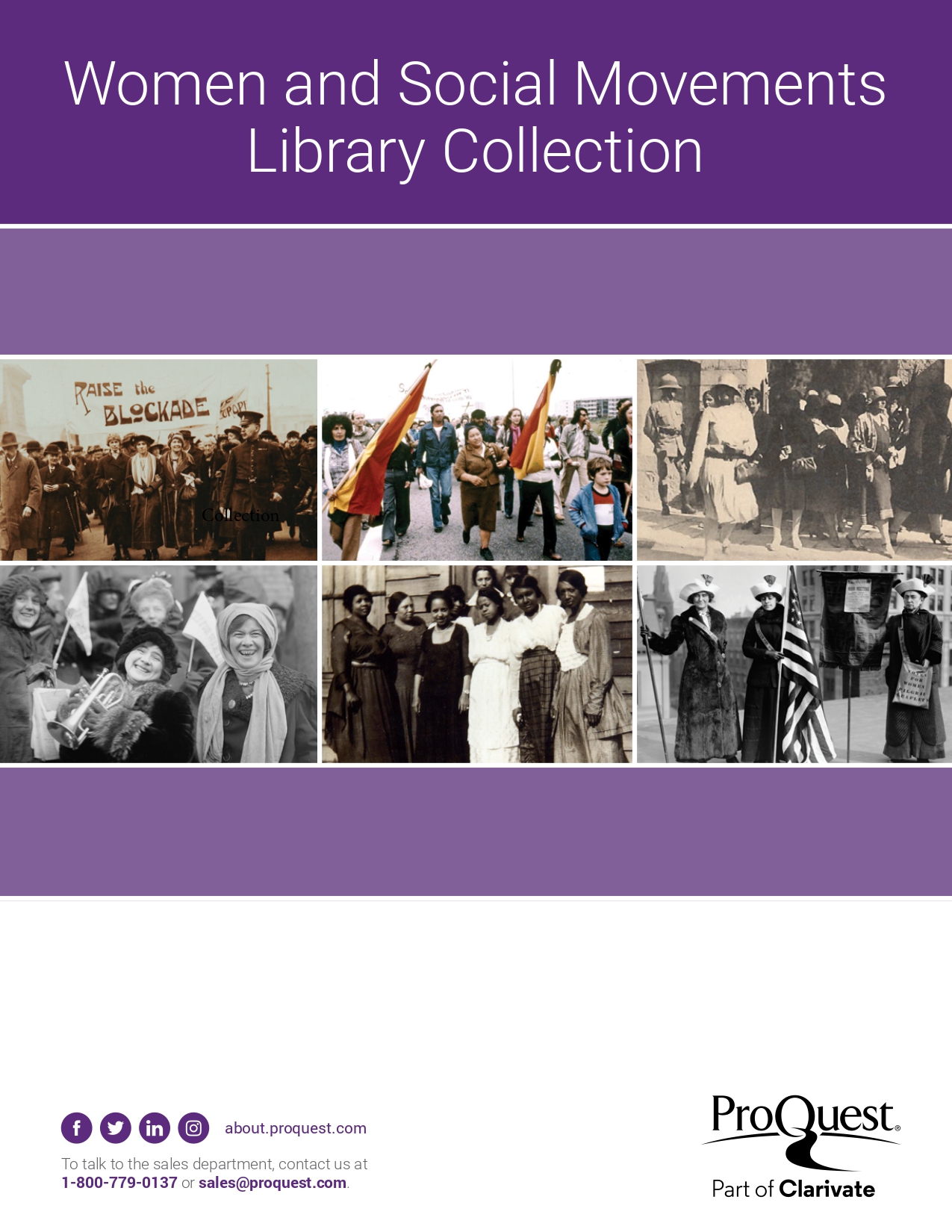 Women and Social Movements Library Collection
 -
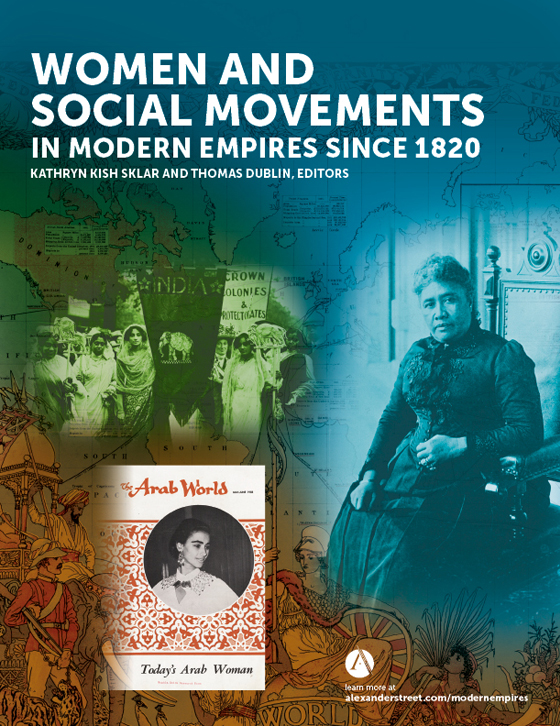 Women and Social Movements in Modern Empires since 1820
 -
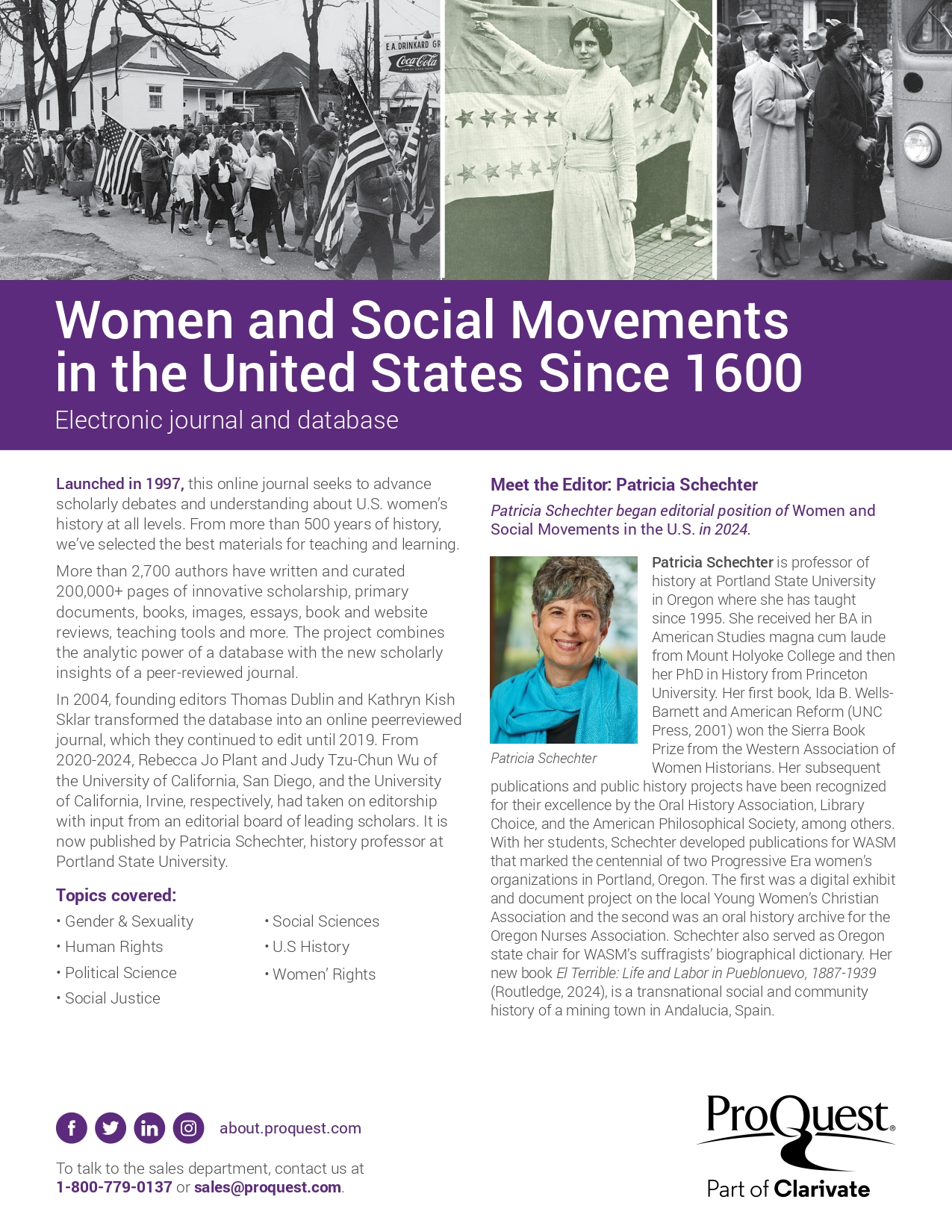 Women and Social Movements in the United States Since 1600
 -
 Women and Social Movements: Development and the Global South, 1919–2019
 -
 LGBT Thought and Culture
 -
 LGBT Studies in Video Series
 -
 British and Irish Women's Letters and Diaries: Second Edition
 -
 North American Women's Letters and Diaries
 -
 North American Indian Thought and Culture
 -
 Australasian Literature Online


