|
Ethnographic Video Online
A visual encyclopedia of human behavior and culture, online in
streaming video.PREPUBLICATION ANNOUNCEMENT
Sign up now to receive automatic Sneak
Peek access as soon as it's launched.
A comprehensive online resource for the visual study of human culture
and behavior and the largest, most affordable streaming video collection
of its kind, Ethnographic Video Online will contain more than 750
hours of classic and contemporary documentaries produced by leading
video producers in the discipline; previously unpublished footage from
working anthropologists and ethnographers in the field; and select
feature films. Wherever possible, videos include accompanying field
notes, liner notes, filmmaker biographies, related articles, study
guides, and other context-enhancing, full-text materials. Publishing
partners will include the leading video content providers in the
discipline, including Documentary Educational Resources (DER).
At the core of this Alexander Street collection are hundreds of the most
frequently assigned films in anthropology, ethnography, and social
psychology courses. Targeted for inclusion are works by world-famous
pioneers in the field, including Edward Curtis (In the Land of the
War Canoes); Robert Flaherty (Nanook of the North together
with his article, “How I Filmed Nanook of the North”); John Marshall (The
Hunters, the entire !Kung Bushman Series; A Kalahari Family);
Jean Rouch (Jaguar, Les Maitres Fous); Margaret Mead and
Gregory Bateson; Robert Gardner (Dead Birds, Rivers of Sand,
Forest of Bliss); Timothy Asch, Patsy Asch, and Napoleon Chagnon
(the complete Yanomamo Series, The Ax Fight); and Asen
Balikci (the complete Netsilik Eskimo Series). Select feature
titles in the collection include interviews with these and other classic
filmmakers as well as retrospective considerations of their work, plus
films that address practical and philosophical questions about the
discipline.
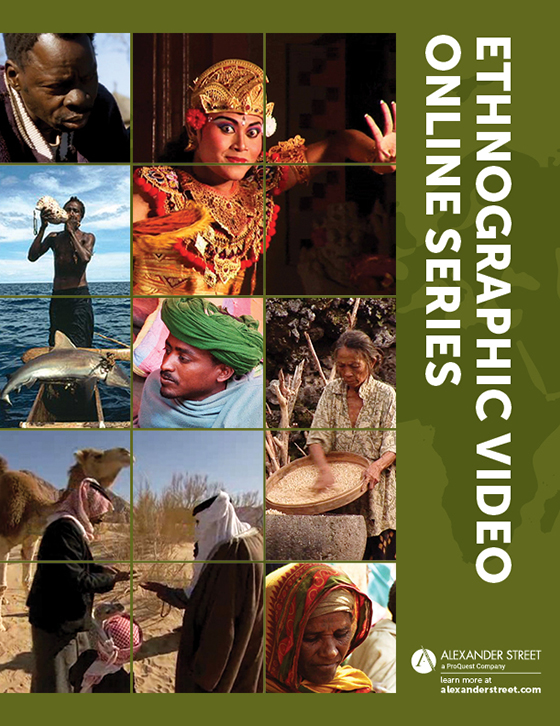
Global in scope, Ethnographic Video Online includes footage from
every continent and hundreds of unique cultures, and is particularly
rich in its coverage of the developing world. Contemporary works in the
collection include films from the most innovative ethnographic
documentary-makers world-wide, including Australians Sarah Elder,
Leonard Kamerling, Nicole Ma, and Michelle Mahrer; Raju Gurung of Nepal;
DaKxin Bajrange of India; Italy’s Caterina Borelli; Hu Tai-Li of Taiwan,
Japan’s Ikeda Hajime; Johannes Sjoberg and Ton Otto of the Netherlands;
Danish filmmakers Christian Suhr Nielsen and Steffen Dalsgaard; China’s
Wen-jie Qin and Wang Bing; Ana Marķa Pavez of Chile; Mexico’s Juan
Francisco Urrusti; and John Bishop of the U.S., to name just a few.
Importantly, the collection will also include a wide range of indigenous
media, from early experiments (such as the famous The Navajo Film
Themselves series, produced in 1966), to works from modern-day
indigenous film production companies and other projects, including the
DER Video in the Villages Presents Itself series and Jeff Arak’s
documentaries about indigenous media, Voice Through Film (2006)
and Those With Voice (2008). These materials allow researchers
and students to compare indigenous to Western documentary approaches and
will encourage dialogue on the practice and philosophy of visual
anthropology.
Among the content published online for the first time will be “hidden
archive” collections and privately held footage from working
anthropologists and ethnographers in the field. By bringing these
materials together and making them cross-searchable, the collection
opens up new possibilities for research and study in the discipline.
Thematic areas include: language and culture, kinesthetics, body
language, food and foraging, cooking, economic systems, social
stratification and status, caste systems and slavery, male and female
roles, kinship and families, political organization, conflict and
conflict resolution, religion and magic, music and the arts, culture and
personality, and sex, gender, and family roles. A core collection for
use across the curriculum—from introductory anthropology and sociology
courses to advanced interdisciplinary courses in women’s studies,
economics, and international studies—Ethnographic Video Online is
Semantically Indexed to enable cross-cultural comparisons. Compare
kinship ceremonies in Asia with those in Latin America, for example, or
contrast gender roles in different regions of Africa. Researchers can
quickly identify and compare footage by theme, cultural group,
geographic location, date of filming, filmmaker, type of behavior, and
much more. The collection also makes it easy to analyze how the practice
of and discourse surrounding visual anthropology have changed over time.
Functionality for scholarship and classroom use include:
- Synchronized, searchable transcripts run alongside each video.
- Visual tables of contents let you quickly scan each video.
- Permanent URLs let users cite and share video.
- An embeddable video player lets libraries and instructors
deliver video content to other users on secure Web site pages or via
course management systems.
- Rich playlist functionality lets users create, annotate, and
organize clips and include links to other content.
- A wide range of supplemental full-text resources, including
filmmaker biographies, course and discussion guides.
- Permissions for in-class, on-campus, and remote-access viewing
are all included in the terms of the subscription.
Publication Details
Ethnographic Video Online is an online collection available to
academic, public, and school libraries worldwide via subscription or
outright purchase of perpetual rights. No special setup or software is
required—all you need is an Internet browser. For more information, to
request a free trial or price quote, please email
sales@alexanderstreet.com.
|